

Futureproofing #39: Confessions II Made Me Realize Music Is Madonna's Best Album
Yes, Ray Of Light exists, but this 2000 LP is Madge at her most fearless and forward-thinking.

Editing and additional research by Tom Gledhill
Like so many other gay men in the past few weeks, I’ve been revisiting a lot of Madonna records, binging old videos, reading interviews, and watching highlights that reminded me that—flops and cringe eras aside—Madonna is a real person with a real sense of humor. She doesn’t care what anyone thinks. So what if she randomly had a British accent, and if she can’t act for shit? It doesn’t matter. She’s Madonna, and she’s made some of the best music of the past 50 years in any genre.
Madonna is most convincing when she’s coming from a position of power. It’s why Confessions II feels warm, fuzzy and triumphant: she’s leaning into her strengths, riding high off a campaign that reasserted her dominance in very Madonna ways—a free concert in Times Square, but also a vinyl version of the album you could only order through Grindr. She tapped into past glories just enough, commanding fans to listen instead of begging them to pay attention. She’s telling stories about Danceteria in the early ‘80s while still catching the mainstream, even if her net’s cast a little narrower than it used to be.
Confessions II is not Madonna’s best album. Neither was the first Confessions On A Dance Floor. But I’ve been thinking: what is? It’d be easy to pick something like Like A Prayer or Like A Virgin, but those records have their clunky moments. You might say True Blue, for sheer cultural impact. Or maybe The Immaculate Collection, the first compilation that collected non-album singles like “Into The Groove” and “Vogue.” A certain kind of contrarian old head might choose Erotica. Let’s be real: no one’s picking Bedtime Stories (though it is very good). So that leaves the obvious choice: Ray Of Light—her most tender songwriting and vocals wrapped in subdued (but convincing) electronica, capturing a pre-9/11 world wowed by the promise of technocracy and syncretic spirituality.
And sure, Ray Of Light is a masterpiece. But it’s also restrained, couched in woo-woo language, soft to the touch and loving even at its most surging (”Skin,” “Sky Fits Heaven”). William Orbit’s sumptuous production polished ‘90s electronica into something that could fit in at the club but also the dentist’s office (alongside anodyne Madonna ballads like “You’ll See“ and “I’ll Remember“), with breakbeat and acid house motifs smoothed of all their edges. It was a genius commercial move, earning her future-music street cred while building a cuddlier, more maternal image. Helped by the Evita soundtrack that preceded it, Ray Of Light cemented Madonna’s mature comeback—singing lessons and all—and won her a handful of Grammys, the ultimate acknowledgement of grownupness.
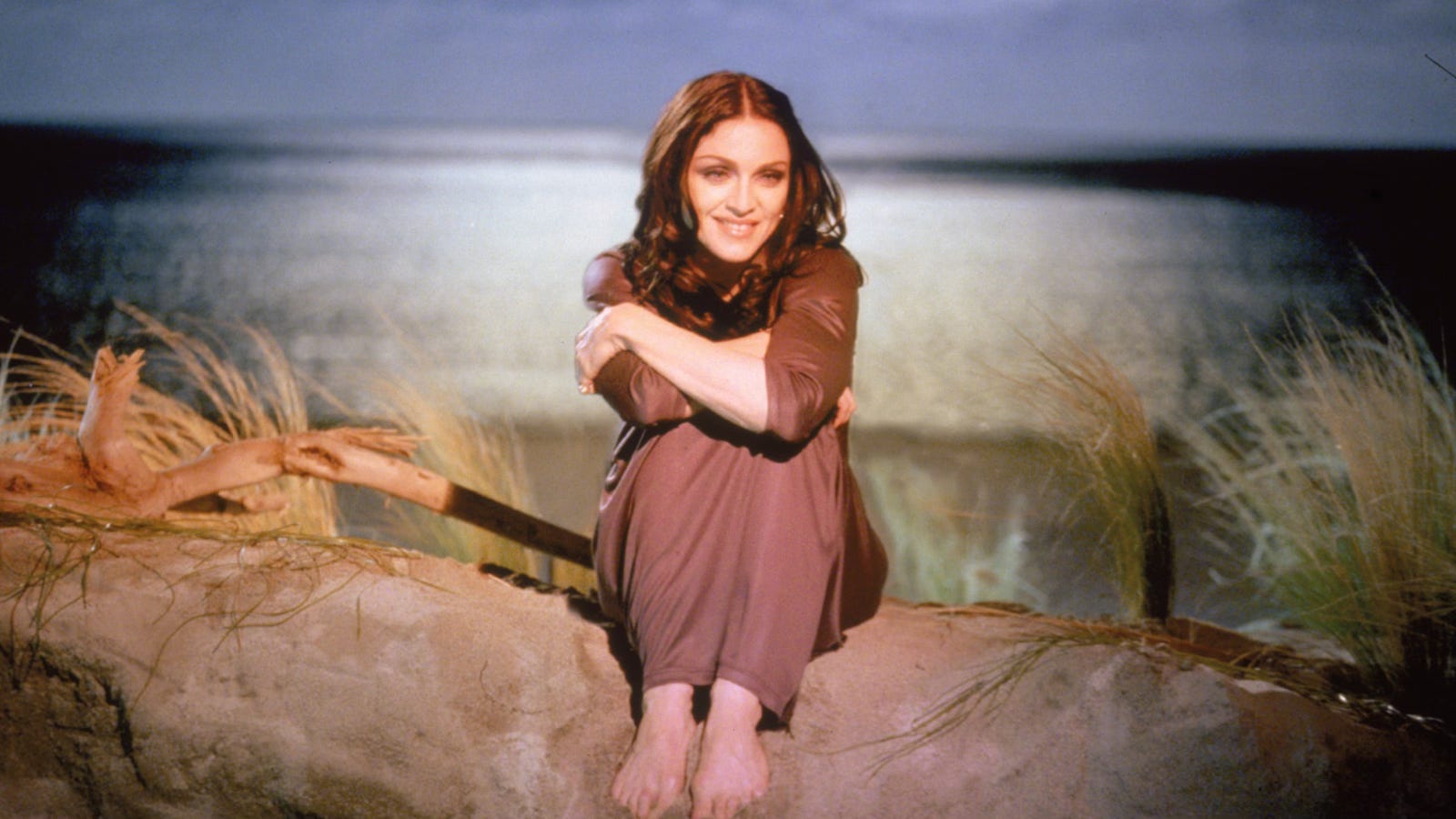
But that’s not the Madonna we were used to. If Ray Of Light was Madonna at a yoga retreat, then its follow-up Music is Madonna getting back in touch with her id. The Madonna who makes over-the-top sexy videos and writes dance floor bangers with silly lyrics. The Madonna who goes on a murderous vehicular rampage soundtracked by the strains of a song about how hard it is to be a woman and be taken seriously. Music features some of her most inescapable songs, a second career-peak that nearly equaled her ‘80s run in cultural ubiquity, if not cold hard chart success.
The sprint to Music started with, of all things, a cover of Don McLean’s “American Pie,” a long and winding song synonymous with early ‘70s FM radio, lifted from the soundtrack to Madonna’s box office bomb The Next Best Thing. Hollowing the track’s lyrics out to a basic pop form and saddling them with a pleasant but limp William Orbit instrumental, “American Pie” became an unlikely global smash, topping charts worldwide at a speed Madonna hadn’t seen in years. It was classy, overtly American, and its retro-future clash was au courant at the turn of the millennium. Suddenly, everyone cared about Madonna again. What would she do next?
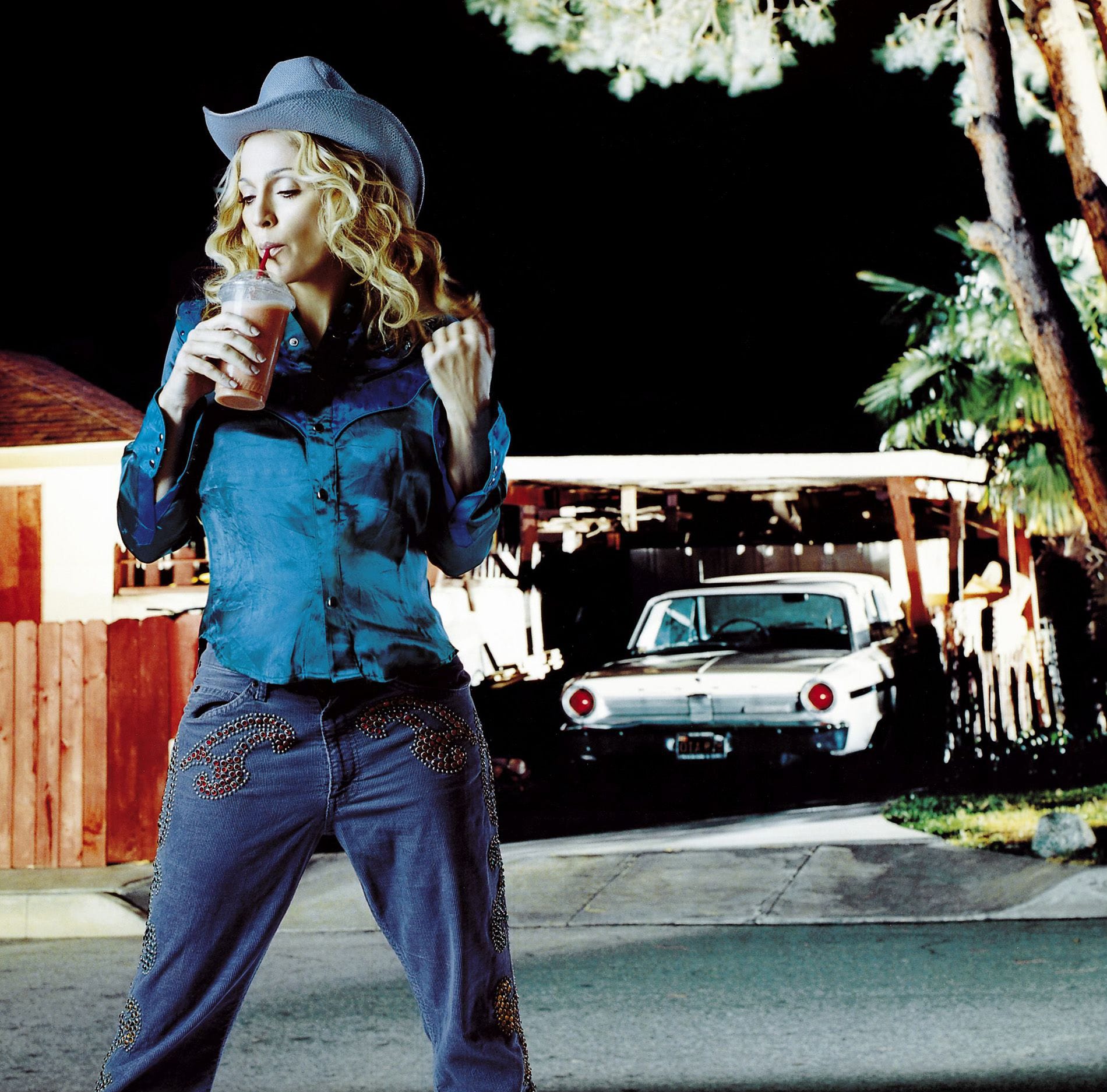
She’d put on a cowboy hat and party in a limo full of strippers with Ali G, singing about dancing and the bourgeoisie over an instrumental that lurched and heaved like someone on a mechanical bull trying not to spill their champagne. Music’s title track and first single was built on the bones of writhing, squelchy acid house and ‘80s electro, with a “Planet Rock” reference thrown in. This maximalist racket was the opposite of Ray Of Light, and it came from Mirwais Ahmadzaï, the French-Afghan producer who gives Music the X factor that makes it Madonna’s best album.
The production on Music is nuts, and most of it comes from Ahmadzaï, who could barely communicate with Madonna due to a frustrating language barrier. (Eventually they brought in a translator, but tensions were high.) It’s a very year-2000 cocktail of influences, yet pop music has almost never sounded as brave and borderless as it did here, from the Global Underground prog surge of “Impressive Instant” and its infamous gibberish bridge, to the warbly AutoTune ballad “Nobody’s Perfect,” which took the robot bliss of Cher’s “Believe” and made it sound alien and lonely years ahead of T-Pain (no surprise, given Mirwais was one of the first producers to weaponize the effect at all)
Though the production is dense, the songs are short and relatively simple. They’re heartfelt to the point of embarrassment (“This guy was meant for me,” she sings on the lovely “I Deserve It,” about her husband named… Guy) and, often, vulnerable. Especially on the closing run that starts with “What It Feels Like For A Girl”—a trip-hop torch song that might be her masterpiece—and “Gone,” which wrestles with her legacy over a cyberfolk instrumental that leaves her voice naked and stark.
But one song lords over all others on the album. Chances are if you think about Music, you don’t think of the surprisingly hard speed garage of “Runaway Lover” or the sultry spoken word French of “Paradise (Not For Me).” You think of “Don’t Tell Me,” the Ahmadzaï-produced single that outdid “American Pie,” and was Madonna’s last great world-conquering hit (though “Hung Up” is a close second). [Ryce note: Correction: “Hung Up” was bigger in more countries. Thanks to Sky Ferrara (not Ferreira) for alerting me to my error.]
In some ways “Don’t Tell Me” is the ultimate Madonna song, sarcastic and winking, but also kind of profound in a way that’s hard to put your finger on. The stuttering guitar sample is Y2K-via-’80s-heartland-rock, with all the soulful authenticity of a plastic bachelorette party cowboy hat. (Even the single cover kind of looks like a still from Toy Story.) But the hokey Americana-isms are what make it great, including its iconic sorta-country video. Madonna’s voice gets more confident as the song trucks along, before strings that could have been floated in from Björk’s Homogenic paint the sky cotton-candy pink. It’s a snapshot of the pure musical possibilities of the early 2000s, which is really Music in a nutshell. Madonna gets plenty of credit for her edgy videos and universal pop hits, but not enough for pioneering the sound of pop itself, which started with Erotica and culminated in Music: sexy, futuristic, but still totally approachable.
🎯
I couldn't agree more with every word.