

Futureproofing #38: Robert Henke on making music, then and now
With the reissue of Monolake's transitional 1999 album Interstate, Henke spoke to me about the early days and how his creative methods have changed since then.

Edited by Tom Gledhill
For a name synonymous with some of the most foreboding, serious-sounding techno in the genre’s history, Robert Henke is a pretty funny guy. I’ve encountered him in various settings over the years, but my favorite recent reminder of his wit came while doing research for this interview. On his well-annotated website, the section for the Monolake Magenta 12-inch says: “A strange release, but we had fun doing it. The Prophet VS was new, the weed was fine, and who cares if a bass drum is panned fully left. There are a lot of things going on in these two tracks, but certainly nothing one could call a groove.” Pithy and self-deprecating, it’s vintage Henke, whose sense of humor has always felt more dryly English than German.
I was revisiting old Monolake tracks thanks to the new reissue of 1999’s Interstate. This second album captures Monolake back when it was still a duo with Gerhard Behles (but before Torsten Pröfrock occasionally hopped into the producer’s seat). Interstate is a transitional record, not quite as glamorous or influential as Hongkong and Gravity, but its in-between nature is actually its strength.
A purposeful break from the Basic Channel-isms of Hongkong, Interstate launched Henke’s own label and abandoned dub techno tropes in favor of something more complex. It’s not exactly IDM, but it’s not straightforward techno, either. Tracks like “Gecko” operate as intricate, hard-to-follow mechanisms of interlocking machinery—instead of driving forward, they seem to spin wildly on their own axes. There are still a few bridge tracks, like the dual versions of “Tangent,” where cracks begin to show in the old Monolake formula. But those boundaries are completely blown apart by the deconstructed drum & bass of “Ginza”, its drums slowed down and spliced to pieces—and the ominous rumble of ten-minute journey “Abundance,” where patterns coalesce only to skitter away, occasionally blotted out by massive pads and sudden brief moments of near-silence.
“Abundance” hints at the rhythmic mastery Henke would later achieve on his own with tracks like “Bicom“ and “Atlas.” While those went on to become some of the most totemic techno records of the 2000s, Interstate more than deserves its own reappraisal. It’s a 1999 album that sounds like it could have dropped more than a decade later, pushing (then newly-released) Max/MSP software to its limits. Henke, after all, is nothing if not an early adopter of technology. I caught up with him to discuss this transitional era of Monolake, how his creative process has evolved over the decades, and the very nature of creation itself.
What do you think makes Interstate special or interesting in the Monolake catalog?
It was a strong departure, intentionally, from the Chain Reaction / Basic Channel sound. While I felt comfortable in that environment, and still do, I felt that it was a bit restrictive. And we didn’t want to be labelled as a Berlin minimal techno dub outfit. Because we both also had an interest in more broken beats—we had an interest in academic computer music and all kinds of different things that did not necessarily fit under the Chain Reaction / Basic Channel umbrella.
Interstate is quite different in color and structure from the stuff we did for Hongkong. Which was intentional, because we didn’t want to repeat ourselves. And then some of it is just down to incident. We tried out new technologies, new methods, and the results were completely different sonic material.
What new things were you trying out?
Mainly a lot of granular-based stuff. Sometimes it’s obvious, sometimes not. Both Gerhard and I worked independently on some granular synthesis software. I was using Max/MSP. And he wrote the sampling modules for what later became Reaktor as a job. So he briefly worked for Native Instruments. These prototypes of the sampling modules for Reaktor, and my granular stuff in Max/MSP, are responsible for the sonic qualities of Interstate.
Like what? What are those sonic qualities?
A lot of things were… in abundance. Like in the first track, which is recursive in a funny way. There’s a sample in it that is played so often that it’s basically the whole track itself, and then there’s a part of the track itself that is a sample, resampled and played back as a loop. Stuff like that. Or the ambient textures in the background that just have this lush, harmonic quality.
And also the step sequencing for this one was very much driven by our explorations in Max/MSP. So Interstate has a different palette in many ways.
To me, a lot of sounds on the album feel like… real things, as opposed to the hazier textures of the Chain Reaction stuff.
That makes sense. We continued the tradition of sneaking in processed field recordings, so there’s still some insects and some crickets and things like that, hidden somewhere underneath those effects.
Where are the field recordings from?
You ask questions! [laughs] Back in those days I used a small Sony portable DAT recorder. And whenever I heard something interesting, I just pressed record. So no specific geographic location that is remarkable in itself. Just collections of sounds.
Wait. I believe there’s one track, “Terminal,” that has a sample recorded at Charles de Gaulle Airport in Paris. The announcement sound of that airport was composed by one of the big French computer music composers from the INA GRM. Ah, yes, it’s Bernard Parmigiani. “Indicatif.”
I applaud the French government, or whoever is responsible for that. That they had the balls in 1974 to say, “Let’s have a computer musician designing the announcement sound.” So there’s a sample of that sound embedded in the real announcement in the track. Which is, of course, a reference of a reference of a reference. I like those little details that are embedded in other details.
Why did you like the sound of insects so much?
I find it amazing how synthetic they sound. Insects can sound like a modular synthesizer and a modular synthesizer can sound like insects. It seems to be a perfect blend. There’s also this enormous spatial component to insect sounds. I remember once I was on holiday or traveling for gigs in Australia in the bush. And in the afternoon suddenly on one side a bunch of crickets starts. And then on the other side crickets answer. It’s a call-and-response, left and right. But then there’s more coming from the front and more from the back. It’s just amazing what kind of high spatial resolution you can get from them. If you close your eyes, it becomes a mess of things.
But at the same time, you can zoom in on all these details. And this brings me back to my approach to music from this time. It’s quite dense. But ideally there’s still all the details there that you can explore and listen to carefully.
I feel like tracks like “Gecko” and “Perpetuum” are really dense. How did you write or structure these tracks? How much was planned?
“Gecko” is definitely doing some strange step sequencing. And I remember that Gerhard ended up doing this rhythm that I thought was really twisted, in an interesting way. We decided to leave it that way. “Gecko” was one of those tracks that made us think, “Do we really do this now?” I’m happy we decided that yes, that’s what we’re going to do. Instead of trying to streamline it into something less odd.
Interstate was the last record with Gerhard, right?
Yeah.
So what did he bring to the project that you couldn’t do by yourself?
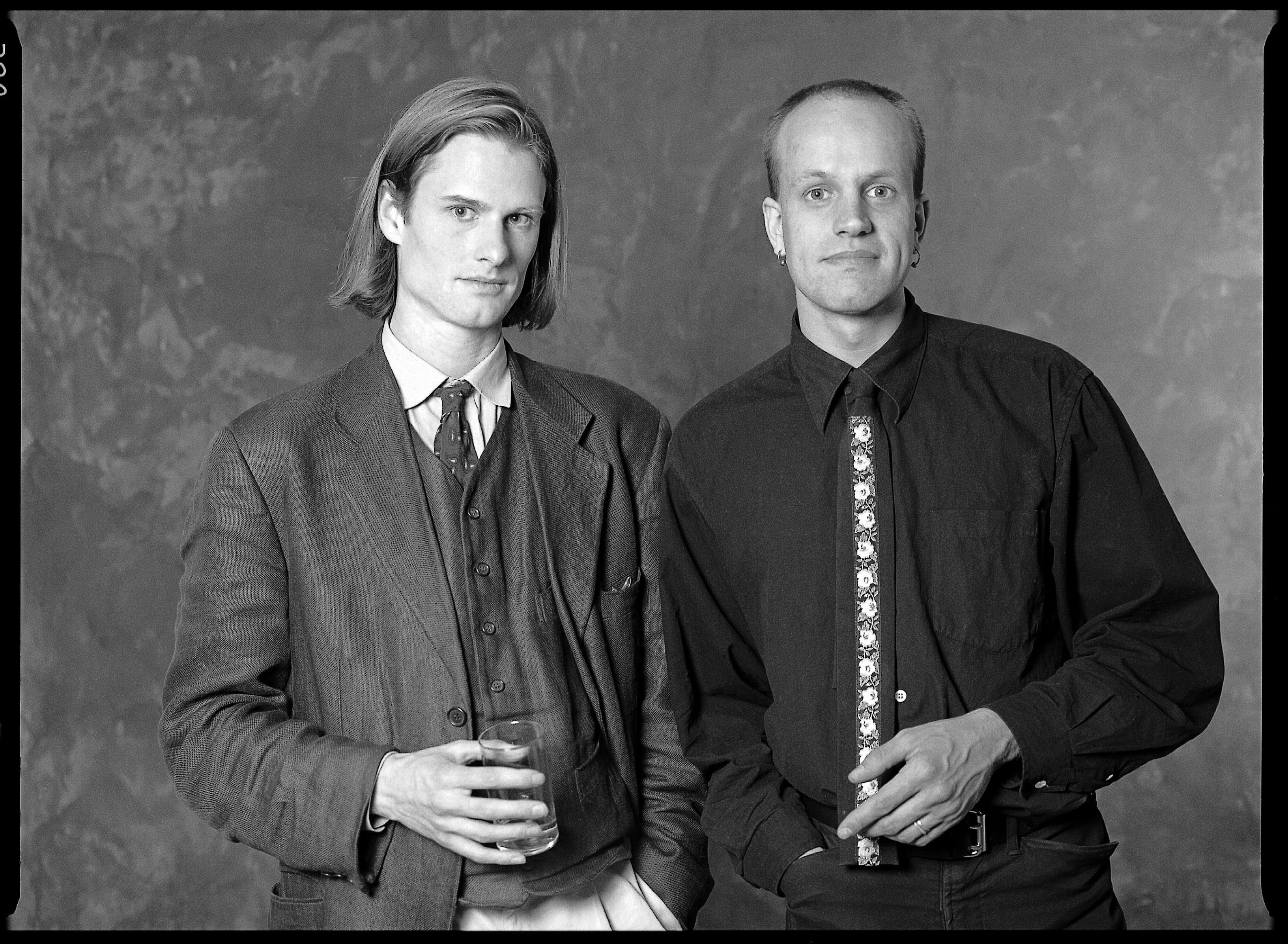
Well, as Gerhard pointed it out in an interview we did some 10 years ago, I’m very much into detail. Almost compulsively. And I really enjoy diving deep into small things. And this leads me to adding and adding more stuff. I could do this thing here, and I could add a delay here, and we could do something else there. And let’s have some other element coming in from there. And Gerhard was usually pretty good about saying, “Okay, we don’t need this element now. We don’t need this note at this point in time. We don’t need this note at this part of the beat.” Gerhard cleans up the mess and I fill it up with interesting sounds.
When things went well, we created this equilibrium. It led to music that was dense, but never felt arbitrary.
And so what happens after he leaves?
Quite frankly, it led to a massive crisis. Because I thought, “how am I supposed to continue doing what I’m doing?” But as usual in my life, those crisis situations ultimately end up being fruitful because they force me to rethink my strategies and my goals.
I made a kind of internal summary of the aspects that Gerhard contributed and how I could transform those aspects into things that I’m going to do in the future. You can never fully replace a creative person with another creative person. That’s the beauty of creativity. It’s all individual. However, you can learn strategies.
So I started to apply similar strategies as the ones I learned from Gerhard. And I think in retrospect it worked out quite well.
Strategies… like what?
Stepping back at some point and thinking about what is too much. Looking at simplicity as a value in itself. Scrutinizing every element for its necessity in a specific situation. Those kinds of things. Embracing structure a bit more. Saying, “OK, let’s have a more rigid frame here that holds it all together.”
Was there a lot of structure to the tracks on Interstate? Because some of them feel very chaotic.
We didn’t plan anything. The working mode at this time was step sequencers, samplers, synthesizers, effects, and the mixing desk. And we couldn’t afford something like a multi-channel recording solution. So the only way to record it was to jam and to record it on DAT tape and stereo. And Gerhard had access to a Pro Tools system at the Technical University, and we were editing some tracks there. That was the mode for Hong Kong, actually. For Interstate we had the ability to edit tracks down in stereo at my place. I bought a ridiculously expensive sound card for Pro Tools. A stereo input-output card for €1,000 or something like that. That is really, really absurd. But this was a time where computers didn’t have any audio input-output. This was the Digidesign Audiomedia III card. A big, big thing with two DSP chips on it. And I have no idea what they did.
We were basically editing down these sessions into shorter versions. I have original sessions that are sometimes 30 minutes long, sometimes an hour, sometimes only 10. And they contain the original material. And then I really edit the stereo like you would do on tape. Thinking, “okay, this part is great, this part can repeat a few times, this part needs to go.”
Was there any particular theme or inspiration behind the music on Interstate? I mean, “Gecko” kind of sounds rainforest-y to me, or at least like nature.
No, not really. We recorded many more sessions than what made it on the album. Interstate itself is already a selection. And at any given point in time, you have certain influences and you have certain preferences. And that is usually already enough to get a certain amount of coherency into a product or into a musical release. And that’s more or less what we did for Interstate. We just perceived it as a nice sound palette, and a nice journey from A to B to C. And this is also why we chose that name, because you’re on a highway travelling from one thing to another. And you go between different states of emotion, color, whatever.
What are some places that come to mind when you look back at the making of Interstate?
Not really existing places. As in, “this is the Bavarian Alps,” or “this is Palm Springs,” or something like that. It’s more a mental state. Or let’s put it this way. If it’s a physical location, then it’s more an imaginary physical location. Which is not entirely true, actually, if I think about it again. There’s “Ginza” on the album, which is the shopping district in Tokyo. And there’s also some field recordings from... Ah, this is good. I’m remembering a bit more. Ginza field recordings. So there are some places that have a physical location.
Sometimes I add the field recordings, then the title comes out. Sometimes I have an idea for what this is supposed to be. And then I check if I have some field recordings that would potentially match.
I like that answer, but I was asking more about the places you were while you were making the album.
Oh, that’s easy. Berlin, Charlottenburg. This was classic bedroom producing. So either Charlottenburg, where Gerhard’s flat was, or at the studio of the Technical University, which was also in Charlottenburg, so it was close by. Gerhard used to work there as a tutor, so it was easy to get access at night, when no one else was there.
Did you have a day job then, or were you just making music?
I was working as a mastering engineer. I was cutting records at Dubplates & Mastering, which at this time was quite a special thing, because we were one of the first dedicated vinyl cutting places for electronic dance music—which, at this time, had different needs than what more conservative record cutting places would do. The idea of a conservative vinyl cut is that it should be transferred as inaudibly as possible, so that when you listen to the vinyl record, you hear the same things as you would hear if you listened to the master tape. But as people in Detroit and other places figured out, if you push the limits of the machinery a little bit, you can get into a territory where things start to really distort in a pleasant way. And in order to shape this kind of specific vinyl sound that makes these gorgeous club tracks on a 12-inch that have this enormous punch and warmth at the same time, you need to be quite creative with the process of transferring.
So if you were that involved in cutting vinyl and making it tailored to electronic music, then why wasn’t Interstate released on vinyl to begin with?
Because it was a collection of 12-inches first. Tangent first came out as a 12-inch. It was also about money. Producing CDs is inexpensive in comparison. There’s lower risk, because if you produce 1000 CDs and you sell 200 of them, 800 CDs is something you can store in your flat. Storing 800 vinyl records is a nightmare. And since Interstate was the first release on my own label, because I said, what we learned from Basic Channel was that if you do everything by yourself, you’re in a pretty good position. But this was the very first release on my new label. And I had no marketing budget. Marketing [for electronic music] then wasn’t the thing it is today anyway. So that would have been a risk.
So this is the third reissue of your old work on Field Records. How does it feel going through it like this? Is it nostalgic? Do you like spending so much time thinking about your old work?
I have to say that I’m positively surprised by it. I’m not one of these people who listens to their own music once it’s done, if I can avoid it. Simply because I’m a very critical person in general with my own stuff. And if I listen to it again, I notice all the flaws that I didn’t notice back in the days. And then I think, “Oh, I should have done this differently. This is too long. This is too short. This is wrong.”
But occasionally something pops up somewhere. Sometimes I’ll be on TIDAL or whatever service listening to electronic music while doing the dishes, and then my own tracks come up. And this is still for me kind of, like, “what?” It’s funny to experience that.
But my experience with these re-releases was that I was pleasantly surprised by how much I can still relate to them. Not only that, but there’s also sometimes this feeling of, “Ah, that’s interesting, what we did back then. I should probably revisit this idea again.” Things that I have forgotten. Certain sounds, certain aesthetics, certain grooves, certain things. I felt at this time, okay, we’re done with that. And now I listen to it again 20 or 25 or whatever years later and realize that actually there’s still room within that specific thing for further exploration. And that’s nice.
I feel like Hongkong does sound very of that time, and of that label. But I hadn’t listened to Interstate in probably 15 years, and I was struck by how modern it sounds. It doesn’t sound like it’s from the ‘90s.
Which is probably the biggest compliment you can give me. I’m always a bit scared of… as an old person…being old. At some point in your career you ask yourself, “what am I doing? Is this still relevant? Is it interesting to anyone?” Noticing that things you did in the past actually are still sounding fresh 25 years later, is pretty nice. It provides me with a bit of a positive outlook on what I’m doing currently.
Did you keep the old patches that you used? Do you still have access to them?
I wish. Back in the day, hard disk space was ridiculously expensive. And my living situation was chaotic. I lost a lot of my old material. I regret that I didn’t have a better backup regime. Because there’s a lot of things from the early 2000s that, in theory, could still be recreated with the old data, if I had it.
So you mentioned, for Interstate, that there were a lot of extra sessions that didn’t make it onto the album. So those are all gone?
No, there are still some DAT tapes. But let’s put it this way. I think we made a good decision. There are things that feel incredibly important whilst you’re doing them. And then you’re listening to them three days later and you say to yourself, “what the heck was I thinking?” And then there’s these sessions where you play it and you feel like, it’s okay, but it doesn’t lead to anything. Let’s just call it a day and let’s go have a drink. And then you listen to these things a few days later and you think, “wow, this is beautiful.” But with Interstate, we made a good selection.
How does your music-making approach, both artistically and technically, compare now to how it was in 1999? What’s the difference?
It went through a lot of changes. In the early 2000s, I had a phase where I wanted to do everything inside the laptop. But then I grabbed my synthesizers and hardware effects and put those back in. Then I came back to a model where I was working on sound, rhythmical patterns, mixing everything on the computer. And then I had a hybrid approach where the studio was alive and the laptop and everything was connected. And that was the most complex scenario. Nowadays I have a much more structured approach to my work: I enjoy my studio as a machine for creating sound. And creating structure in a sketchy way. And then this is one process.
I spend time just creating interesting percussion sounds. Creating them, recording them, editing them, labeling them. Building a library. But not a generic library—a library that is the library of my current interest in that sound. That goes for melodies, or harmonics, or whatever. And then I have all these folders with these interesting sounds. So the next step is to go back to the laptop. And then it’s nothing else but the laptop, where I have access to all these files. I’ll quickly put those files together to create structure. And maybe when I’m in the process of making a piece, I notice that there’s some specific thing that is still missing. And then with this almost finished piece—or at least this sketch of a piece—I go back into my studio [with my hardware] and try to find that one missing sound, if I couldn’t find it with software.
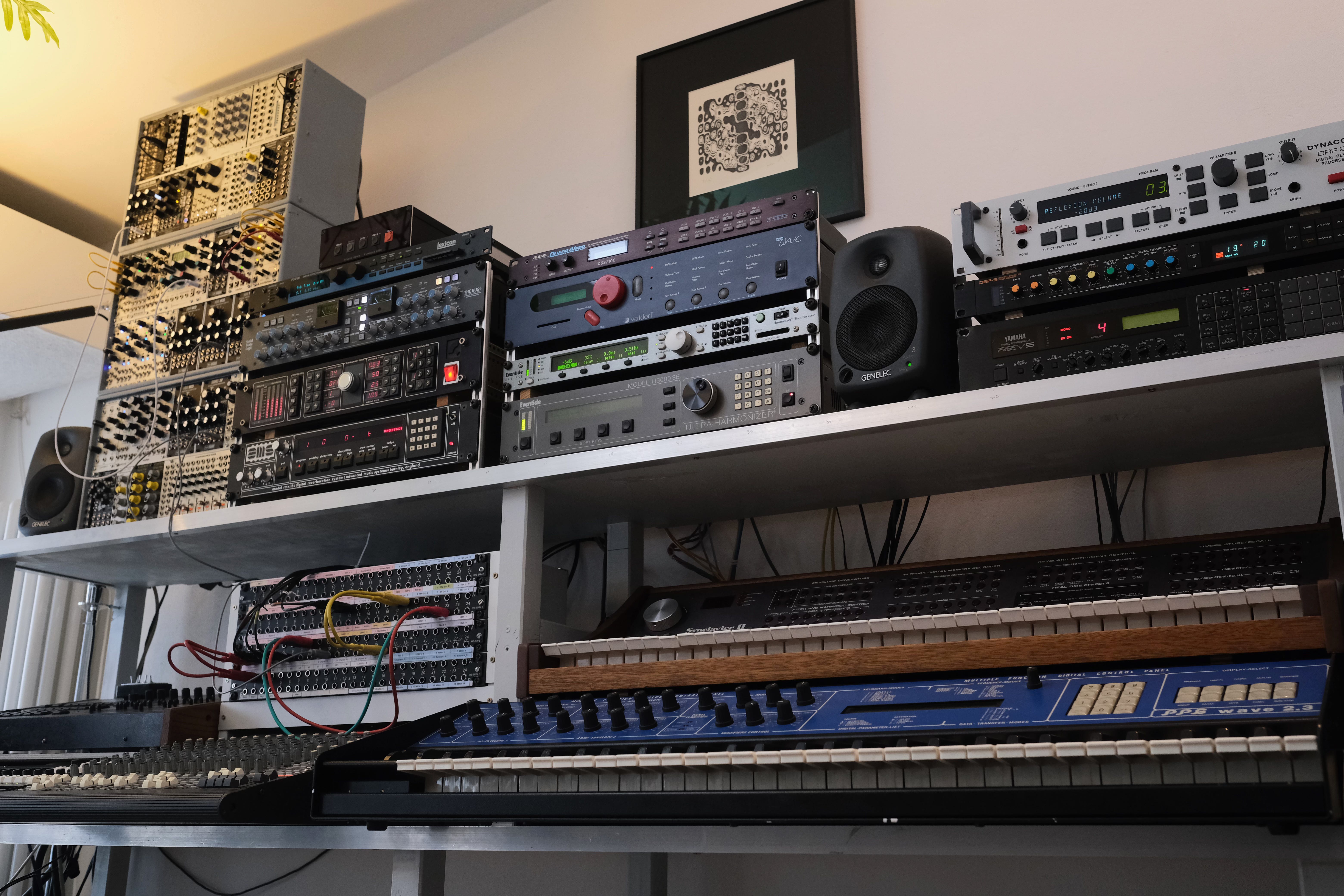
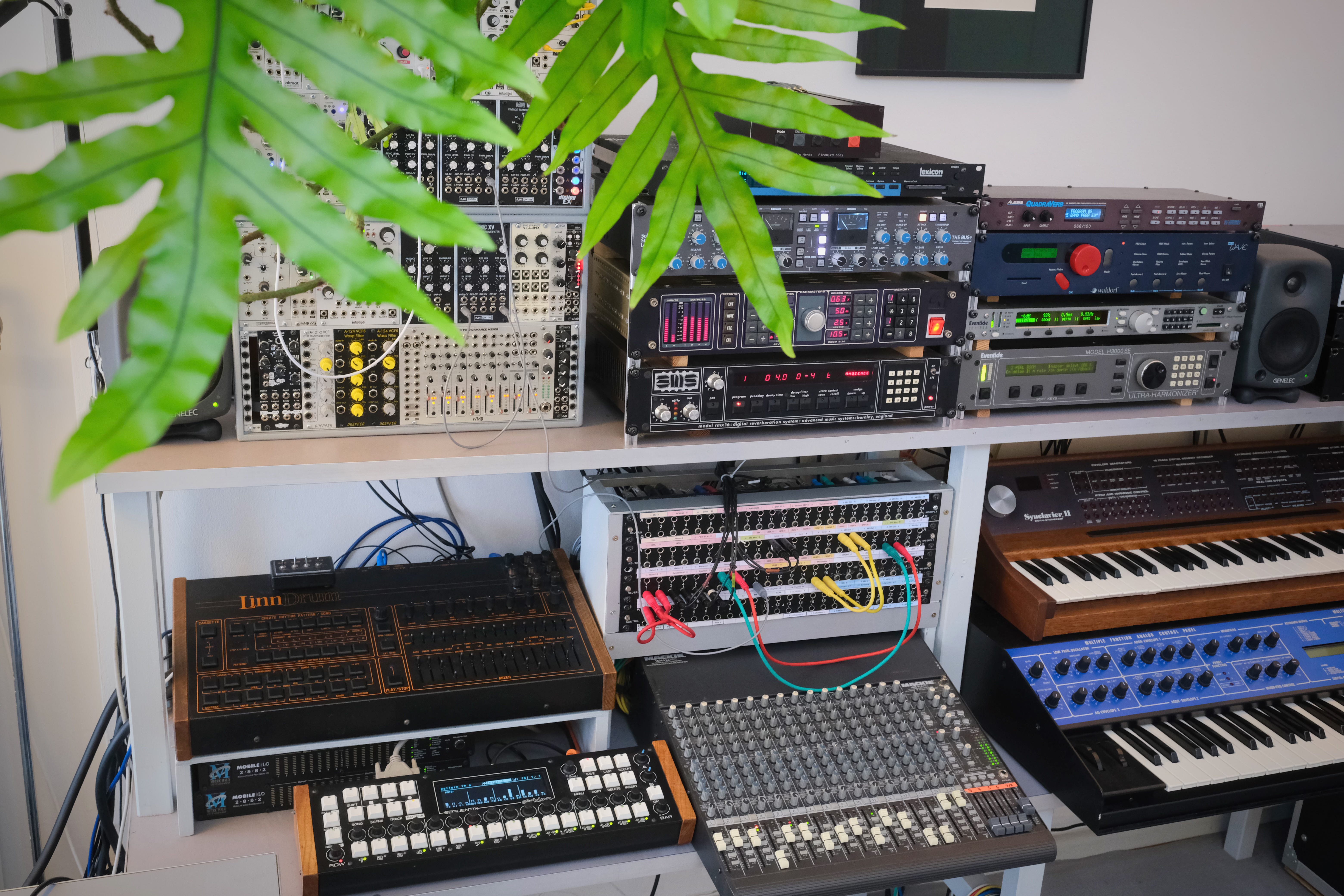
I still like my studio for entirely metaphysical reasons. From a sound perspective, there’s nothing I couldn’t do in a computer now. There’s millions of things you can only do in a computer. There’s absolutely no need to buy another analog synthesizer when it comes to creating sound. Even if you are into modular synthesis, you can have a virtual modular rig in your laptop and you’re fine too. So the reason why I still like my studio is that sometimes I enjoy being in front of a physical manifestation of an idea.
Every instrument I own has been created by a person or a small group of people who put an enormous amount of dedication into it. In the Linn drum is Roger Linn. In the PPG is Wolfgang Palm. In the Roland products there are the two Roland engineers—one who did software, one who did the hardware, those two made all the amazing Roland products from the late ‘70s, early ‘80s, which we all love so much. There are people behind those things. And when you play with these instruments, you kind of interact with those personalities. With their ideas, with their visions, with their flaws, with everything. I get results from that interaction. That feels valuable to me.
What are some of your favorite pieces of gear in your studio?
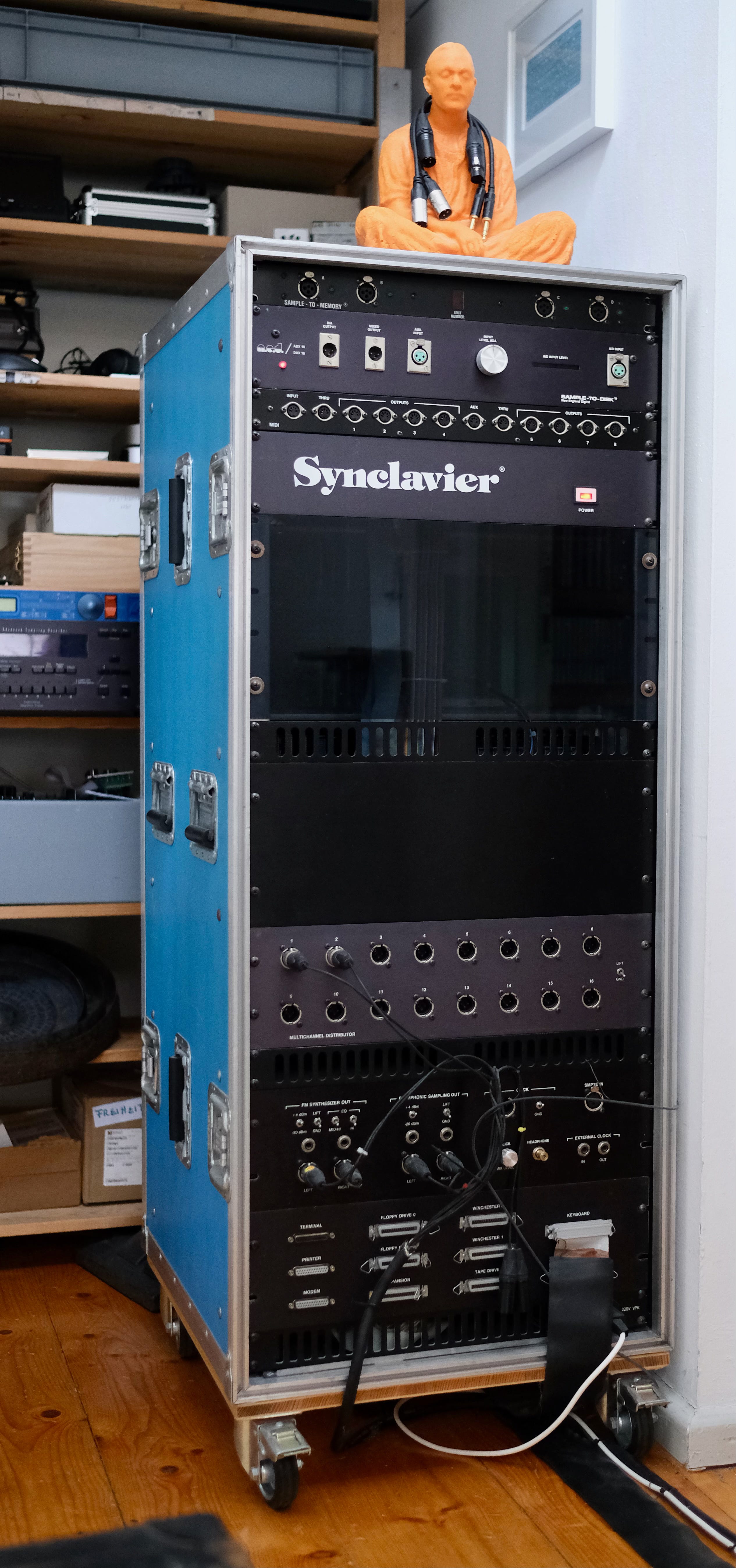
That’s a difficult question, because I like all these things for different reasons. I mean, in a way, the most absurd piece of equipment I have is a big Synclavier tower. It’s absurd because it came from a mindset of, “We don’t care how much it costs. We want to do the best sound quality possible.” And so they had 16-bit stereo sampling at a time when the competition had 8-bit in mono. It was just incredible brute force.This whole tower which eats two kilowatts and has 32 megabytes of RAM on cards that are as big as a 12-inch vinyl record. It’s a very strange piece of equipment from today’s perspective. On one hand, it’s completely outdated. But at the same time, it radiates this kind of desire to push the boundaries. And on top of that, it still sounds great. If it didn’t, then I wouldn’t use it. Because I’m not a collector for the sake of collecting stuff. I collect machines that I really like sonically.
But there is still absurdity in powering on this big tower. Explaining to people who are now in their early 20s, when I have friends that age coming to visit me, and I show them this thing. It’s so bizarre to them that a synthesizer is the size of an American fridge.
So what do you use it for?
I use it as intended: for sampling things, playing them back at different speeds, and doing very basic sample manipulation. But also as the equivalent of a grand piano. I load a piano sample, add a Lexicon reverb, and just play it. That seems to be appropriate. Also, the keyboard is great.
But if the question would be, which instrument would I take on an island? I would certainly not choose the Synclavier. I would probably choose E Osmose, because it’s the one that is most expressive in a small form factor. And it’s contemporary—it has all the interesting options that you can have these days. It’s not my favorite yet, because I still need to learn it. But if there’s one thing I needed to carry out of my studio to continue making music with a piece of hardware, that would be it. It’s also smaller and lighter than the Synclavier.
You said that you admire the Synclavier because it represents people trying to push the envelope and do new things. So how are you doing that with the music you make now? How are you pushing the envelope?
My philosophy about artistic creation in general is that I’m against this idea of the single, lone genius. There is always a mutual influence and a mutual co-development of styles, ideas, visions, whatever. I listen to stuff that I find interesting, regardless of genre and release date. I take this in with my momentary state of mind, and I try to do something that is still me, but of course I’m very much influenced by whatever goes on in the outside world.
I just try to make things that make me feel good when I’m doing them. Because ultimately that’s the reason why I make music. I make music for myself. And if other people like it, that is a tremendous gift to me. But it’s not the main motivation.
I don’t need to innovate as a goal. I want to create something that makes sense to me when I do it. I don’t want to repeat myself, and of course my influences change over time, and I’m paying attention to how music is currently produced. Like, what kind of tricks are people using? Can I find anything in these tricks worth exploring by myself? But by taking these ideas I’m not just copying them. I transform them into something that makes sense for me. Because taking the ideas is a selective process.
From all the ideas that are out there, I take a tiny subset and incorporate it in my work. And that means the result usually has nothing to do with the initial idea. For instance, just something that comes to my mind right now without any specifics here… Obviously I’m not a singer. I would never consider adding my own voice to a record. Well, you should never say never, but it seems unlikely. But anyways. I can listen to Billie Eilish or the chopped up vocals on FKA twigs records, and find it musically interesting and inspiring. Though it will not lead to me doing exactly the same thing they are. It might lead me to take a computer generated voice and treat it in a similar fashion. There is a mutual influence from what I take in from current production and current composition and aesthetics and turn into my own thing and put it out. And what other people are listening to, including maybe my stuff. And deciding that there are elements they dislike. And decide that there are elements that they find interesting. And develop their version of it. This is how we all operate. So I don’t know if I’m innovating or whatever. I just do what I like and I hope that people like it.
We started off talking about an album that came out 27 years ago. How do you keep yourself excited about electronic music now?
Whenever you think you’ve heard it all and you’ve seen it all. Or there’s stagnation. Something shows up in some unexpected corner. I think the beauty of art is that it’s completely open-ended. Even within the most basic arrangement of objects, there are endless possibilities. Things develop further, sometimes in very unexpected ways. This is true both for the general evolution of art. But it’s also true of what I do by myself. I recently became much more interested in very different types of complex harmonic progressions. I did not intentionally work towards that. It just happened that suddenly things that I would not have done five or 10 years ago feel interesting to me. And feeling interested means that I have fun doing it. I do my little piano session where I’m just doodling for my own personal happiness. And suddenly my fingers do things that they didn’t do before. I think, “Oh, that’s nice. What are you doing, finger? Can you do this again?”
There is something happening that is beyond my control. Something that I can just accept that is happening. And that’s super powerful. I believe the best art is something that happens because it has to come out, or it comes out by a happy accident. And then the challenge is to notice the happy accident. I think that my idea of artistic creation and also an idea of a lot of engineering and scientific discovery is you have to build a system that allows for happy accidents.
You have to have a hunch, a vision, some feeling that in this corner something is hiding. And then you dig deeper in this corner. And if you have good luck, suddenly something pops up from there. And you say, “Oh, that’s beautiful.” Or, “really? This is in here?” And then things start to become alive. And then, of course, I still have these moments where I’m euphoric about the result.
The same is true for performing live. Not every gig is great. Not every gig feels like the invention of the wheel. Sometimes gigs are just bad—mediocre gigs where you think no one would have cared if I just stayed at the hotel. Well, maybe not that bad. But there are these moments where you play somewhere and you feel that suddenly, again, out of slight shifts in the things you always do, something new emerges. And there’s a new type of connection with the audience. And you feel like, “yeah, this is what I should do. This is exactly the right moment in the right place.”